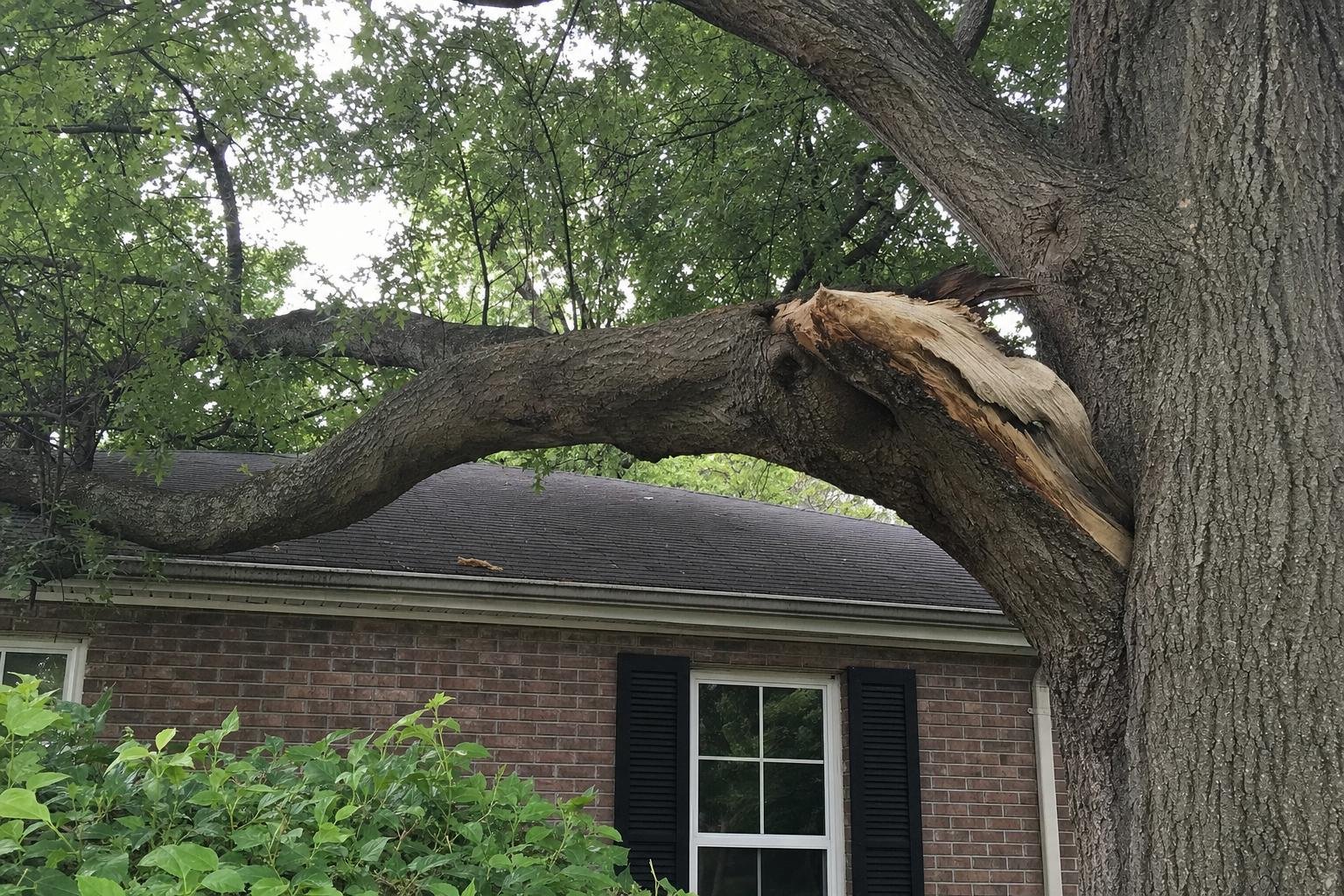
Weak branch attachment
What's behind it: Branches with weak unions may break when bearing weight.
What we check first: Evaluate branch connections and if the tree can take a support system.
First a look at the job, then the price in writing. Free Quotes, no pressure.
Fast Scheduling
Call us with the details you have, there's no commitment.

No obligation
Call (423) 672-1913How this works
A limb has come down on the roof, or the big tree by the house seems to lean a little further each season, and you want to know if it's a real problem. We're a tree service covering Johnson City. Call and describe the tree and where it stands, and we'll book a walk through the site. After that walk you'll have the quote on paper, along with our opinion on whether the tree needs work at all.
Most of the housing here isn't old, but the trees around it have had time to grow. The median home was built in 1983. Nearly two-thirds of the city's homes went up after 1970, and the biggest building wave was the 1980s. A tree that stood a sensible distance from the roofline when the house was new may be hanging over it now.
Most homes are single-family houses, with apartments and mobile homes mixed in. Over a mobile home or an apartment carport there's little room to drop anything and more to damage underneath, which a backyard tree rarely has.
Seasonal temperature swings add stress to limbs that were already weak. Moisture in the ground also changes through the year in ways that affect foundations, so when a large tree stands close to a house we look at the ground and roots near the foundation as well as the canopy.
Most of what we do is removing trees that are dead, leaning, or too close to a structure, and pruning or taking down damaged limbs before they come down on their own. Some jobs are a single limb over a garage. Others are a whole tree taken down piece by piece because a fence, a roof and a neighbor's yard are all within reach.
We also clear lots of brush, overgrowth and trees that have to go so a property can be built on or used again. When a storm drops a tree or a big limb on something, call us. The first questions we ask are what was hit and whether anyone is at risk.
Not every tree needs us. A tree that looks rough but is healthy and sound can often stay, and sometimes pruning is the right answer instead of removal. If the damage is to the roof once the limb is off, that's a roofer's job, not ours.
No. Whether to grind the stump depends on what you plan to do with the spot. If you're replanting, building or just want grass, grind it so you're not mowing around a knee-high obstacle. If it's tucked in a back corner where nobody walks, it can wait, and we'll say so.
The logs are the other leftover. If you want them for your own stove or fire pit, tell us when we walk the site so we know what gets hauled and what stays.
We work on commercial and rental properties as well as single-family lots. On apartment grounds the trees sit near parked cars, walkways and buildings other people use, so alongside the usual look at the tree we plan how to keep the area clear while the cutting is going on.
If you manage a property, you'll get the quote in a form you can hand to an owner or board for approval: what's being cut, what's being hauled, what happens to the stumps, and what the site looks like when we leave.
Before we quote anything we walk the site. We note overhead lines, damaged limbs, how much the tree leans, nearby structures, traffic and unstable ground. Next we look at the tree's health and structure, because that tells us whether it can take a climber, rigging lines or the load of cutting. From the street a tree can look solid and still be hollow or cracked. If it is, we may not put anyone in it and will reach it another way.
The job then goes in order. We decide how the tree comes down or gets pruned, set up around whatever's in the way, do the cutting and rigging, and clear the debris. Sometimes dead wood or a weak union shows up once we're in the canopy. Any change to the plan gets explained to you first.
We try to avoid the quick cut that takes off the obvious problem and leaves the cause. Taking off a single hanging limb is a reasonable job on a sound tree. If the tree itself is failing, trimming the limb just buys a few months.
Several things about the tree and the site build the price. Size and height matter, as does how close it is to the house or power lines, whether we can get equipment to it or have to climb and lower pieces by rope, how much wood has to be hauled, and whether you want the stump ground. A leaning tree over a roof costs more than a tidy one in an open yard because it takes more care and more rigging. We confirm the exact number after we've seen the job, and you have it in writing before we start. Stump and wood arrangements go in that same quote, so there's nothing to argue about afterward.
Whether a permit or inspection applies depends on the property and the kind of work. We raise it when we walk the site, and anything that applies goes into the quote so it doesn't surprise you later.
Take a photo or two from where you can see the whole tree, and note what concerns you: a dead limb, a lean, a crack, roots lifting near the foundation. If it looks like it could drop something, keep people and cars out from under it. That's all you need to do.
Then call. We'll ask where the tree is, how big it is, what's near it and what you've noticed, then arrange a visit to look at it in person. The call costs nothing and doesn't commit you to a job. You don't have to decide on removal, pruning or stump grinding on that call. After the site walk you'll have our written quote and a plain read on whether the work is needed now, can wait, or isn't needed at all.
What's typically behind each of these, and how we confirm it.
What's behind it: Branches with weak unions may break when bearing weight.
What we check first: Evaluate branch connections and if the tree can take a support system.
What's behind it: Limbs might have grown into areas that block a building.
What we check first: Check branch clearance and the cuts needed to clear the obstruction.
What's behind it: Limbs might be dead, diseased, weakened, or harmed in a storm.
What we check first: Inspect the affected branches and their attachments.
What's behind it: A clear tilt may indicate instability, while root disturbance, decay, or weak attachments may lead to failure.
What we check first: Check the lean, root area, trunk, and main branch unions.
Each one suits a different situation; here's when it's the right call.
No guesswork about what comes next:
One quick call is usually enough for us to understand the work and the timing.
We size up the work in person so the quote is real, not a guess.
The scope, the timeline, and the price go on paper before you agree to anything.
The work gets done and checked, and the site is left clean.
No obligation
Call (423) 672-1913How this works
Late dormant season, usually late winter to early spring before buds swell, is ideal for most species. Pruning then minimizes sap loss and disease risk. Avoid trimming during active growth or fall, when wounds heal more slowly.
A medium tree 30 to 60 feet tall typically falls in the $725 to $1,350 range. Smaller trees under 30 feet usually cost far less, while anything over 60 feet quickly climbs higher due to equipment and safety needs.
Most areas do not offer standard free removal for seniors. Some municipalities or nonprofits run limited assistance programs, but eligibility is narrow and wait times are long.
Late fall through winter is often less expensive because demand drops after leaf season. Crews can schedule more easily, and frozen or bare ground sometimes simplifies access. Savings vary by region but are usually modest compared with peak spring and summer months.
Fast Scheduling
(423) 672-1913Talk it through with us at (423) 672-1913, and it costs nothing to ask.
Get My QuoteAvailable across Johnson City, TN, and whether you're in Elizabethton, Jonesborough, or right in Johnson City, the process is the same. Call (423) 672-1913 to check coverage for your address.
7 communities on the list.
Serving Johnson City, TN and surrounding areas.


